
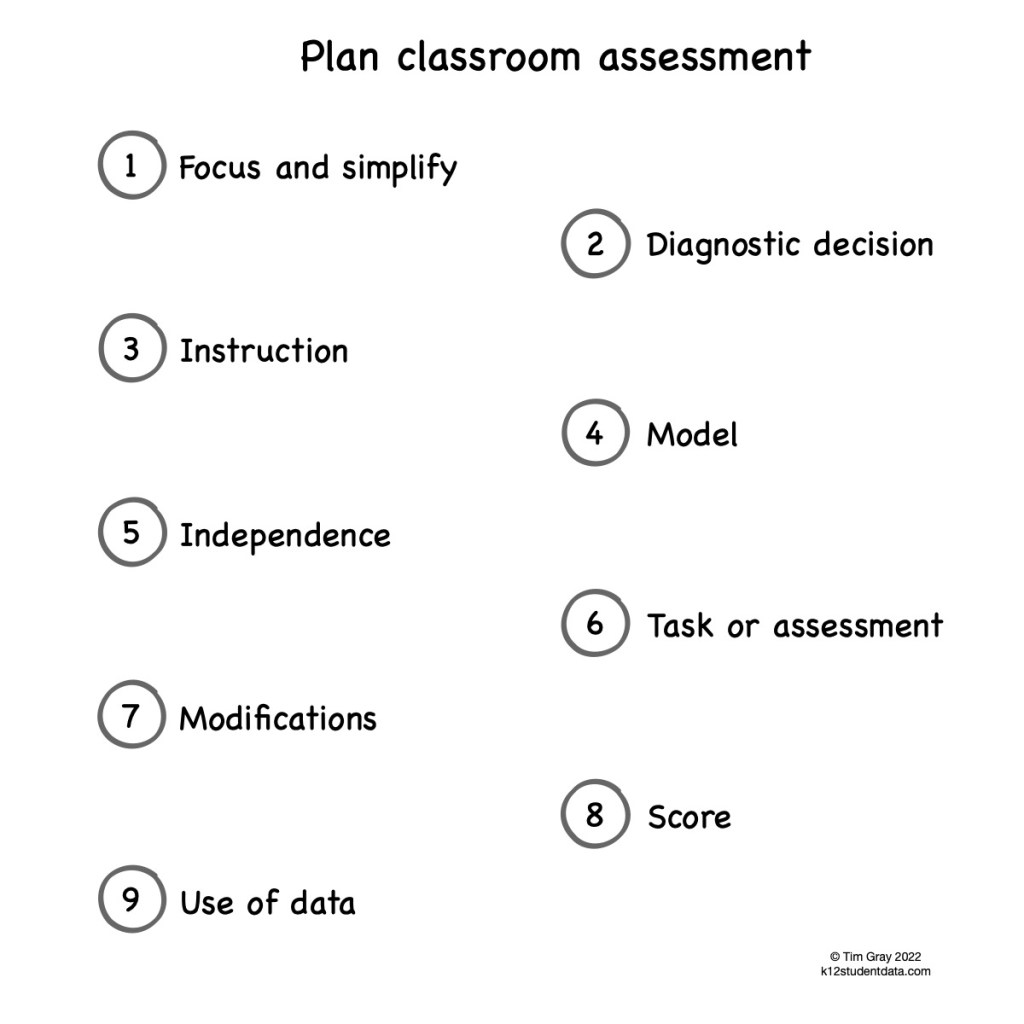
Why do we need this test?
Why am I administering this assessment?
Why am I taking this assessment?
Purpose of the assessment
Define the purpose of the test with the need for the data, and the use of the results.
Questions to determine need
- How will this assessment support learning and instruction?
- Why do we need the student data?
- What use do we have for the student results?
- How will the data be used to help students improve learning?
- Will the results help future instruction or intervention decisions?
- Is the data going to be shared?
- How will feedback from the assessment help our students?
- Are all students expected to take the test?
- What accommodations are acceptable?
- What intervention will we use to improve future learning?
Focus each assessment on your instructional goals and needs.
- Outline or blueprint the assessment.
- Select a test format that best suits student and teacher needs along with the instructional focus.
- Include passages, items, and prompts that match the skills, knowledge, and concepts from your outline.
- Balance rigor and complexity of the assessment with passages, graphs, and illustrations students used during instruction.
- Avoid items that cue or answer other items on the test.
- Create an assessment students complete in a normal time schedule.
Review and question the items
- Does the item and passage mix assess the skills or concepts in more than one way?
- Is each standard, skill, or knowledge included matching instructional or learning requirements?
- Does each item test the standard fairly as taught in the classroom?
- Is there a proper mix of item difficulty and complexity for each concept overall?
- Does every item measure a skill or content identified in the plan or outline?
- Do the questions work together to create a complete picture of student learning?
- Do any question cue or help answer other items?
Classroom reading assessments
Passage considerations
- Rigor and complexity appropriate for current students.
- Measure learning in the context of current instruction and content knowledge.
- Students have the background knowledge to understand reading.
Passages not in context to instruction and requiring extensive background knowledge lower student performance. The data will not provide enough insight into learning, especially for English learners and students struggling with current content.
Long passages rush completion
If the reading load is too heavy, students will rush to finish the assessment.
Balance text complexity
Balance grade level text complexity to best measure student achievement. If a passage pushes the boundary of complexity, look for indicators within the passage that help plan future instruction. Is the reading hard, but fair and using the appropriate content matter?
Make reading worth the student’s time
The length of the passage justifies the number of items used to assess the reading. Be careful, too many items exhaust a passage.
A long passage supports more questions, but using too many items will over-burden the text. It causes queuing, one question helps a student answer another question.
Passages support more than one standard
Be careful not to ask too much of the passage.
Appropriate vocabulary in passages and items.
The passage mix should challenge students, but not all reading has to be complex. The use of many challenging and complex passages will lower performance for many students, especially those struggling with grade level reading.
Math assessments for the classroom
Math standards work together
Include standards within a cluster or domain that complement each allowing the test to measure concepts not just individual standards.
For example, in elementary grades place value can be evaluated using items identifying place value, rounding numbers, and addition with regrouping. Students show their understanding of place value in different but connected ways.
Items address concepts in different ways
Selected response and constructed response items working together provide a better picture of student thinking and learning.
Grade level math vocabulary
Using grade appropriate math vocabulary, along with mixed item types will provide a better understanding of student learning needs.
It will be important to decide what modifications or support will be available for students that may not understand the question due to reading skills, not math proficiency.
Use grade appropriate numbers
Include questions with varying digits, length, and the types of numbers.. For example, if testing fractions, select items with a variety of denominators.
Watch complexity and difficulty
Assessments that are too hard or too easy will not provide instructional or feedback value.
Be careful not to over-test a concept or standard
Typically 5 – 10 items with mixed complexity or difficulty will provide valuable performance data. A test can provide indicators of learning for the classroom teacher with 3 to 4 high quality items per concept.
Classroom science assessments
Effective science assessments measure student understanding and learning of concepts. Standard-based questions should work together to create a picture of student understanding.
- Identify the important idea of the domain to select standards.
- Analyze the skills and concepts within the standards to gauge how they work together to create a learning story.
- Broad standards effect the coverage of learning measured in the test. Because of the complementary nature of science standards, it is common to see overlap and cueing across questions.
- Standards with many skills need more items or a performance task to allow students to show learning across the skills within a standard.
- Science tests easily overburden a concept or skill. This happens often with popular or interesting concepts.
Question the test
- Is the question mix assessing the standards in more than one way?
- Is each standard or domain tested for the breadth required by the language of the standards?
- Is there a good mix of difficulty and complexity for the overall test and each concept?
- Do the content or knowledge items work together to create a complete picture of student learning?
- Is overlap or cueing minimized?
Performance task creation
Questions to ask yourself before creating a performance task
- Is the task filling a gap that other assessments do not address?
- What work will students complete to show mastery?
- Is this a real world or authentic task?
- What is mastery going to look like?
- Why is the performance needed for learning and instruction?
- Is the task worth the time and effort from the students?
Quickly check and review
Quality
- Will this assessment provide valuable data and information?
- Does the test overall, along with each question, measure important content or skills?
- Does the test match instructional focus and intended learning?
Content and skills
- Does each item measure content objectives, and their skills, accurately and appropriately?
- Does the vocabulary for each item match instructional practice, and content area specifications?
- Does the overall test content match actual instruction during the learning cycle?
- Is required background knowledge fair for students?
- Are the questions free from bias?
Thinking
- Does the test require students to show thinking needed at this point in the year?
- Is the thinking required appropriate for our students?
 K12Studentdata
Leave a comment